
Security Monitoring: protecting your business from cyber threats
Hackers or malware, careless or disgruntled employees, outdated or vulnerable devices and operating systems, public and mobile cloud computing, or third-party service providers: in the normal course of business, most enterprises are generally exposed to security threats of varying severity.
Given the ubiquitous and unavoidable nature of security risks, system protection imperatively requires rapid response time, with continuous and automated security monitoring for rapid threat detection and countermeasures.
Security Monitoring, sometimes referred to as “Security Information Monitoring” or “Security Event Monitoring,” involves collecting and analyzing information to detect suspicious behavior or unauthorized system changes on one’s network, defining what types of behavior should generate alerts, and then taking countermeasures based on the alerts as needed.
What is Security Monitoring?
 Security Monitoring is the monitoring process aimed at detecting cyber attacks and data breaches. Real-time monitoring of the computer network is a key part of the work needed to reduce cyber risk.
Organizations that conduct Security Monitoring activities are able to intercept attacks and respond in minimal time.
In terms of risk management, reducing detection and response time through proactive infrastructure monitoring means significantly reducing the possibility of incurring reputational, economic or even physical damage.
We’re talking about an activity so important that companies that handle extremely sensitive data often rely on SOCs, 24/7 operations centers where cybersecurity experts monitor network security in real-time and in person.
How to be prepared
Most cyber breaches are detected after a few weeks, others discovered only after months, and often attack targets involve assets or data of whose existence the organization was not fully aware.
Central among the software and solutions needed to conduct Security Monitoring is Threat Intelligence. These are tools that use data, the expertise of dedicated experts or even artificial intelligence to always have an up-to-date catalog of the latest threats, giving the network protection system the ability to recognize the attack or malware and take action.
Care must be taken, however, not to mistake Threat Intelligence for Security Monitoring. In fact, in order to achieve effective monitoring capable of implementing a real-time response, it is necessary to also adopt other technologies and have a clear strategy.
Technologies such as network security solutions, i.e., approaches aimed at securing the entire enterprise network, including IoT, employee terminals in smart working, etc., can be used to secure the entire network.
In order to protect the entire corporate network from cyber attacks, it is necessary to use a number of additional software in addition to Threat Intelligence. In fact, only the synergistic combination of preventive and proactive actions can make sense of Security Monitoring.
While recognizing the latest attacks is necessary, this monitoring is effective only if it generates a quick and decisive incident response. From this point of view, therefore, it is essential to use information security products with various functions: firewall, antivirus, SIEM, etc.
Telsy’s Security Monitoring
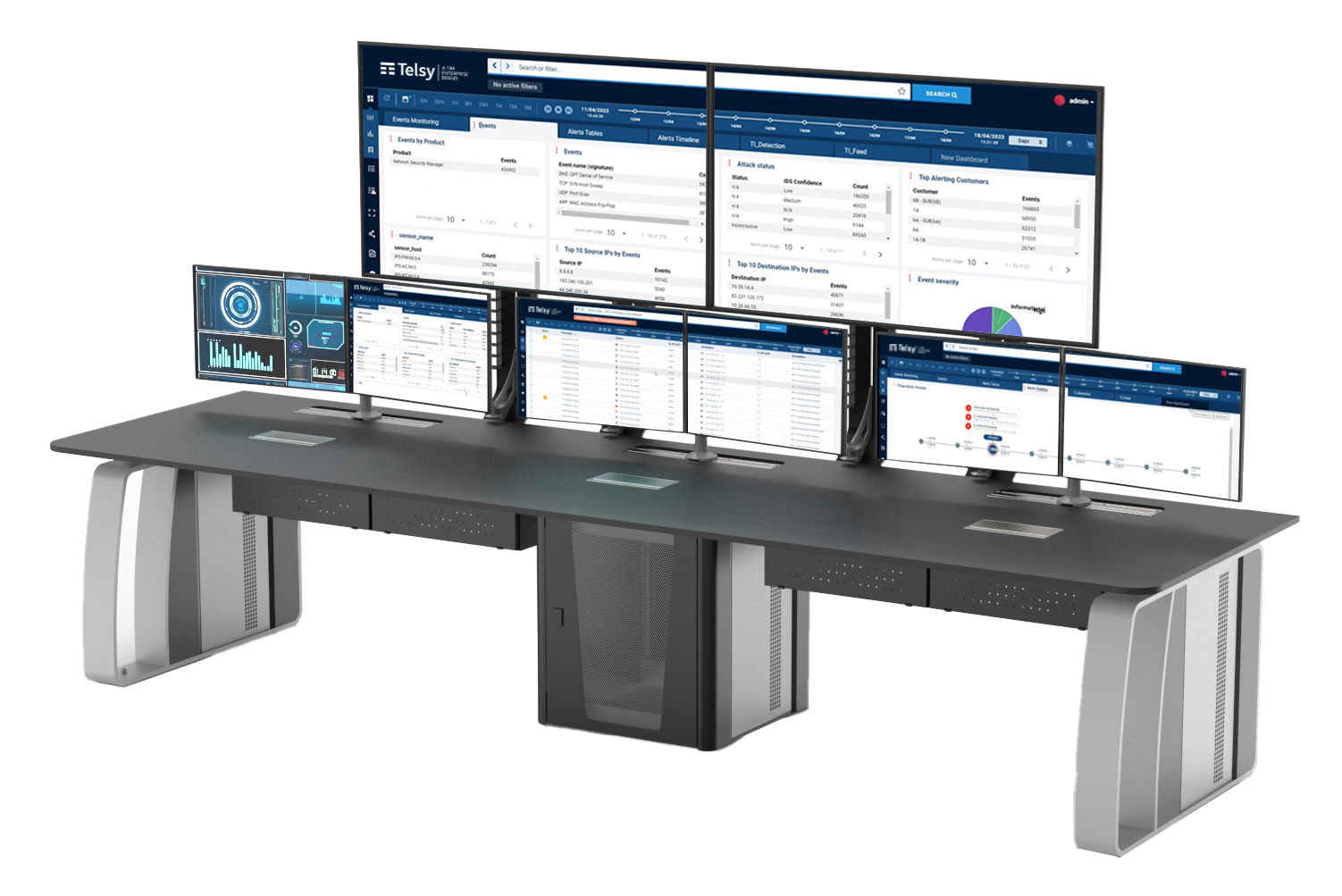 In addition to protecting your business from threats, security monitoring can also help reduce the costs associated with IT security.
For example, by monitoring systems in real time, security problems can be identified and resolved before they cause significant damage, which can help avoid costly remediation.
Telsy provides its customers with a dedicated solution for comprehensive monitoring of ICT infrastructure, which allows them to benefit from the specialized skills of the company’s SOC by reducing detection and response time in the event of anomalies or intrusions.
The service simplifies and optimizes the collection, analysis, alerting, auditing and reporting of all events generated by the ICT infrastructure. All supported by a fast and efficient help desk service dedicated to reception, management of requests, and monthly reporting.
Through tools such as TelsyEDR, TelsyDefenX, Incident Response service, and cyber experts dedicated to ongoing analysis and report production, Telsy’s Security Monitoring service provides security and protection for large and small organizations’ systems, allowing the offering to be tailored to the specific needs of each client.
Learn more at telsy.com